
Foreign Investors in the U.S.: If You Don’t Grasp Federalism, You Will Miss a Lot
People from outside the United States sometimes think they understand the country better than they do. That’s natural, because America’s entertainment industry blasts depictions of U.S. life out to just about every other country’s television, film and music video audiences.
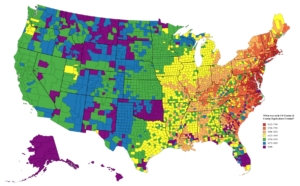
More than 3,000 counties. Which one has your case?
But there is one aspect of American life that many investors, including many from Europe do not grasp at first, and that is federalism – the idea that smaller subsections band together to make a whole country. In doing so, the smaller areas retain a lot of lawmaking and record keeping for themselves.
It’s not that way in France, where there are single registries each for companies and property for the entire country, including overseas territories.
The same is true for England and Wales, and lots of other countries all over the world. I worked with a British company for a number of months some years ago, and every week someone in London would ask me to check “Companies House” (the English term) to see if a particular person had a U.S. company. “Which of the 50 Secretaries of State shall I consult?” was always the answer.
Companies and Real Property
In the U.S., companies are organized by state or territory. There is no concept of a federal company or federal registry of companies. You can be registered in several states at once – one is the place of formation, the others are registrations to do business. Often the home state is the one where you would need to litigate.
In addition, many companies have a trading name that is registered at the state, county or city level. We recently found a company that was doing business as Alpha Electronics in State X, but found that Alpha Electronics was not the real name of the business, which was something else entirely and formed in State Y. All they had in State X was a fictitious name registration.
How much you can find out about a company varies by state as well. Some states have the address of the managing member right on the internet for free. Other states make you pay, and others just don’t provide the information at all without a court order. No two states keep their records in exactly the same way.
Courts
While there are no federal companies in the U.S., there are federal courts in addition to state courts. Within a state, court records are kept at the county or city level, and there are more than 3,000 counties (see map above, color-coded for when the counties were established). They all keep records a little bit differently. Some have everything online, and some have nothing online. Some states keep property records at the county level, some at the town or city level. Marriage and divorce is exclusively a state matter. Bankruptcy is federal, but there is a state procedure called Assignment for the Benefit of Creditors that can accomplish a lot of what bankruptcy reorganization can, which is why we always suggest searching both state and federal courts.
Intellectual Property
Patents and trademarks are at the federal Patent and Trademark Office. Copyrights are the Copyright Office. You can search for those. But trademarks can also be registered at the state level. When you need to know how long someone has been using a particular mark, that can be important evidence.
What’s Private?
Again, that depends on the material and where it is. Medical records, telephone records and banking records are off-limits in nearly all cases. I’ve written for years about the charlatans selling access to banking records they have no right to see, and the failure of law enforcement to shut that down.
But what about someone’s divorce? That depends on the state. In New York, it’s all sealed as to non-parties, except for the docket – you can see a divorce happened and how long it took, but none of the terms. In Massachusetts and a lot of other states, the records are open. Not long ago I found that a company founder had a second foreign company intertwined with his American company, and we only knew this because his wife knew it and mentioned the company in her divorce court filings.
Tax records? Secret, except for not-for-profit entities, tax returns for which are publicly available. The matter of a tax return is an interesting example of the differing definitions of privacy. Many Europeans are scandalized at the idea that their divorce filings could be public, but think little of living in a country where how much you earn is a matter of public record (even if you work for a private company).
Other Records
You can find names of companies people have worked at from election contribution filings. You can connect people through lobbying records (we once established who was behind a new website defaming our client this way). Customs records help tell you how much companies trade, where they land and ship the goods and with whom they trade.
The Takeaway
The U.S. can be a treasure trove of information, but the hardest part of any search can be knowing where to look for it.
