
AI Is Our Tower of Babel
I often tell new clients: “Google yourself. Even if you are very famous (and most of my clients are not), how much of what you know about yourself will be on the web?
For most of us, the answer is, one or two percent of what we know of ourselves can be found on line. We won’t see every place we’ve lived and worked; how we did at school and at our jobs; who our friends were. We won’t read what everyone thought of us when they lived/worked/came into contact with us.
This holds true whether the proposition is “Google yourself” or “Ask AI.” If it hasn’t been written down and isn’t searchable by web browser, neither source will know about it.
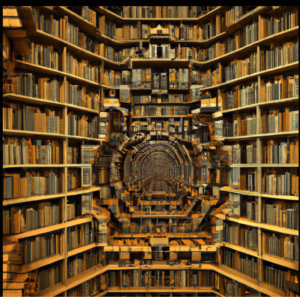
Last month I read for the first time a marvelous story called The Library of Babel by Jorge Luis Borges, who has rocketed to the top of my favorite authors list. Written in 1941, it could have been written today in reference to artificial intelligence.[1]
The story posits a library that extends nearly infinitely upward, and contains every possible permutation of a book of a certain length. There are 25 letters and a few punctuation marks, and each combination is somewhere in the library. Of course, many of the books will contain complete lies, and even though some librarians want to get rid of those, jettisoning these books would still leave books that are 99.9% truthful.
According to the story, the thought among some is that there is a single book that holds the information about all the books, and the one librarian who has access to that single book is analogous to a god. “Many have gone in search of Him.” Borges says the library is just another name for the Universe.
The search for the librarian/god sounds a lot to me like finding the ultimate AI engine that can answer in a matter of seconds any major question that a person cannot.
The idea of a library with everything is not a happy one for Borges. Near the end of the short story he writes, “The certitude that everything has been written negates us or turns us into phantoms.”[2]
What was true in 1941 when Borges wrote in the age of the telegram was also true 20 years ago when Google and the internet were supposed to put bookstores out of business, not to mention investigators hired to find out about people.
What we need to know about people is not all written down and downloadable, and the hope that we can get it all written down, searchable and retrievable is fruitless. Only God knows fully what exists in the memories and ambitions of human beings.
The image of a library extending up uselessly in the sky of course brings to mind the image in the title of the biblical story of the Tower of Babel.
As the late Rabbi Jonathan Sacks wrote, the aspiration of the Tower of Babel’s buildings to reach heaven was laughable.
“Intoxicated by their technological prowess, the builders of Babel believe they had become like Gods and could now construct their own cosmopolis, their man-made miniature universe. Not content with earth, they wanted to build an abode in heaven. It is a mistake many civilizations have made, and the result is catastrophe.”[3]
If you know anything about AI, the number of different potential catastrophes under discussion right now will come quickly to mind.
[1] This has occurred to others too about the story. Librarian Isaac Wink wrote a terrific paper on the topic two years ago.
[2]La certidumbre de que todo está escrito nos anula o nos afantasma.
[3] https://rabbisacks.org/covenant-conversation/noach/a-story-of-heaven-and-earth/
